
The Devil’s Theater
Laws in a free society generally seek to protect the individual’s right to life, liberty, and the pursuit of happiness. Extensions of that see laws that protect the population from the most egregious expressions of religiosity and capitalism that, unrestrained, would install extremist ideology, poison every well, and destroy every ecosystem in pursuit of power and profit.
Common sense would dictate that there’s ultimately a self-imposed moral hazard protecting against these acts of violence. An individual wouldn’t want the extremist’s beliefs of another infringing on their own rights. A company won’t pollute a river that its owners’ families drink from.
Shockingly, we continue to discover that’s not true. On the economic side, this is probably one of the greatest lessons Alan Greenspan - the once-lauded Chairman of the Federal Reserve - who discovered the hard way that greed, in fact, does NOT have a self-protective instinct when it’s drunk on the mindless pursuit of material wealth and power.
Given the room, it will eat itself.
This was the great lesson of the 2008 market crash.
Libertarianism, alas, is a beautiful concept on paper but ultimately fails when human psychology as it actually is plays itself out.
The same is true with unrestrained religiosity. The west regularly looks at extremists like the Taliban as terrorists. Yet are unable to see that it’s precisely the same thing when the Quran is swapped out for the Bible.
Religiosity that’s weaponized to control others fails in its understanding of the nature of an ever-evolving universe.
It’s a small-minded attempt at keeping the earth from its rotation. To suppress the very nature and variety that enables living things to exist and grow and thrive.
It’s necessary to modify or eliminate oppressive laws as we grow in our understanding of the truer nature of human psychology.
The laws that help protect our society’s individuals must grow. To protect the individual, laws must grow with them.
We are currently seeing a wave of laws from the Republican Party that are radical departures from this general liberalism that defines free societies.
Liberalism that protects an individual’s right to practice whatever belief system they prefer. Or none at all.
We are seeing laws enacted that are the exact opposite of protecting the rights of individuals. We are seeing laws that give the government control over that personal expression by individuals. That single, most fundamental right the original framers intended. Individuals who largely are not asking for radical deference from a society but simply the right to be left alone and treated equitable.
Rights that used to be the bedrock of traditional conservatism.
And are, in fact, the foundational premise of the United States. A premise that has yet to be fully realized for all of its citizens.
What has happened over the last three decades is that the Republican Party has discovered that great power can be mined by people who fear the life they are comfortable with adjusting to accommodate this truer nature of the individual. Accommodations that are far less invasive or egregious than simply denying the rights of these individuals altogether.
This realization that this fear has the ability to mobilize and give power to this extremist side of the Republican Party has warped the party from one of individual rights and sovereignty to one that wants government control over the individual.
At least some of its citizens.
This is the precise communism and tyranny they are constantly warning is the boogeyman of the left.
When we see radical laws enacted specifically denying the rights of minority populations, we are seeing performative legislation. Laws that, by most polls, are unpopular with the majority.
Laws that have no real purpose other than to deny the rights of the few and seek to legislate into law the most extremist views of radical individuals.
These laws are not designed to actually “protect the children” as the constant sales pitch assures us.
These laws are designed to oppress the few and signal to the most extreme individuals in society that they are entitled not to equal rights but to superior rights.
It’s a theater of extremist legislation that exists entirely as a performance of dominance.
Distinctly un-American theater.
Or, in the parlance of these radical, anti-American extremists…
The Devil’s Theater.
AI and Human Value
AI is going to replace a lot of jobs.
A job is the creation of value for someone else using the leverage of personal skill and knowledge.
At the root of both of those things - creating value and leveraging a personal asset - ultimately boils down to learning. Learning what product or service has a demand and then acquiring a skill set to fulfill that demand.
Machines now have the ability to learn.
We often derive a skill set based on some personal interest and then go to the marketplace in search of a business looking for that skill set.
The marketplace is rarely efficient in producing human happiness. If you have a job that you love that makes someone else’s life better and you can do it without making another person’s life worse, congratulations… you’ve found the sweet spot.
I’d argue that’s rarely the case, though. I’m typing this on an iPhone. A brief search and I’ll discover a very uneven marketplace of human happiness behind the creation of this object. A quick look into the history of Foxxcon and how lithium is being mined and you realize someone’s convenience is often someone else’s misery.
But you don’t have to be a child mining cobalt in the Congo so I can send dunk memes while I’m on the toilet to be miserable.
While vastly different on the scale of human rights, the slow grind of a cubicle (or the asocial home office) can create a misery of its own.
Yet it’s OUR misery. Keep your filthy AI hands off of it.
What that socioeconomic agreement to be miserable at a job is ultimately about, though, is money.
Beyond the potential social unrest that can be exacerbated by AI’s misuse as a disinformation engine, the real “replacement theory” has nothing to do non-white, non-Americans taking our jobs.
It has everything to do with our centuries old model of how we survive and even thrive in a complex society.
The fascism and authoritarianism we’re seeing bubbling up on the political right is the canary in the coal mine. A society whose collective identity is largely shaped by economic status and material accumulation will ultimately succumb to the smokescreens of fascist religiosity, racism, misogyny, and xenophobia when the means for realizing that identity are out of reach for the majority.
Smokescreens that are exploited by grifters and sociopaths trying to make a buck and usurp power off of serious social unrest.
AI will be taking a lot of jobs. It’s inevitable. People value time more than they value “job creating”. All people are looking to maximize their quality of life in whatever way they define that. Few perceive working more hours and having less quality time as their life’s goal.
It’s conceivable that a future awaits us where a machine can learn and fulfill a good or service far faster and better than humans can.
We will have to redefine our value away from our job titles.
That’s scary for a giant part of the population.
Work often creates a convenient excuse to never actually get to know ourselves.
Our actual value.
AI: Red Teams and Pipe Dreams
OpenAI’s ChatGPT technology has a red team (real people) whose job it is to try to find every possible criminal or violent or otherwise unsavory use of ChatGPT before the general public does. The idea being that what’s learned from these exercises teaches OpenAI how to safeguard the technology so it can’t be used to, for example, tell a malevolent person how to make toxic chemicals from every day chemicals found at your local grocery store.
That task is already an uphill battle given that it’s not always clear to its own engineers how ChatGPT generates answers.
ChatGPT-3, for example, would not tell you how to build a pipe bomb. But if you told it you were writing a screenplay where one of the characters describes how he makes pipe bombs, ChatGPT was more than happy to help you fill in the details.
A simple recontextualization of the question was enough to subvert the technology’s safeguards.
Given the plethora of ways to recontextualize a question, I’m sure there are bad actors busily prompt-engineering ways around Large Language Model moats.
But red teams and server moats are a luxury when the technology is so processor-intensive it’s necessarily behind a giant server stack. That’s an organic membrane between the technology and the user.
But what would happen if another company… say Meta (Facebook), for example… created something similar to ChatGPT and was able to shrink the entire thing down so it could run independent of a third-party data center?
What if it could run unobserved on a private laptop?
And what if that technology was leaked onto 4chan - a site known for racist and violent and largely unmoderated threads?
It did.
Red teams are charming when the technology is hosted. But they are irrelevant when it’s released into the wild.
The Asshole Economy
The revelations that Fox News personalities Tucker Carlson, Sean Hannity, and Laura Ingraham not only don’t believe what they’re telling their audiences but have contempt for their guests who they give airtime to comes as little surprise to those outside of the Fox News bubble.
A bubble created around not just ideology and political affiliation but quite literally on strategies employed by cults.
A media company can’t constrain your physical environment by shipping you off to Waco or Guyana, but it can do the next best thing by convincing you that any other information that contradicts theirs isn’t an alternative view but is actually fake. As in, everything not them isn’t real.
For everyone outside the Fox bubble - liberals and conservatives alike - what Fox News actually is is plain to see. It’s a propaganda arm of the Republican Party.
That’s not hyperbole.
Among the many revelations that have come out in the Dominion lawsuit, we learned that Rupert Murdoch shared confidential information about Biden’s Fox News ad buys during the election to Jared Kushner.
But the conversation tends to end there. That Fox News is just the communications arm of the Republican Party. Presumably to keep Republicans in power.
There’s actually a larger picture, though, that’s not being discussed… why they want power.
Money.
Traditional conservatism used to stand for smaller government, the rights of the individual, fiscal responsibility, and a robust defense.
If you look at the laws they promote… when they’re bothering to govern in between owning the libs and raising money… they aren’t conservative.
They are a business that’s in business to extract money from taxpayers by capturing the institutions of government.
Massive handouts to the wealthy is not conservative.
Banning books is not conservative.
Passing laws that take away women and minority rights rather than expanding them is not conservative.
The Republican Party is the canary in the coal mine for America’s larger problem…
Pitting people against each other to make a buck.
We’re becoming an economy of assholes.
Media has replaced interaction with today’s mantra… engagement.
Interaction is exchange. A transaction. A sharing.
But it has less heat than engagement.
Engagement is getting attention at any cost. An emotional and psychological coercion.
A coercion that often tries to convince you that somebody you don’t know is out to get you. The Cult of the Perpetual Victim.
The cost we’re all paying for this obsession/compulsion is the disintegration of not just Democracy but the fabric of society.
The next time you’re taking in media and you have a strong emotional reaction, ask yourself this…
Who are you making rich by allowing your emotions to be exploited right now?
If you feel angry and empty after these “engagements”, congratulations. You now know the product they are selling…
Destruction.
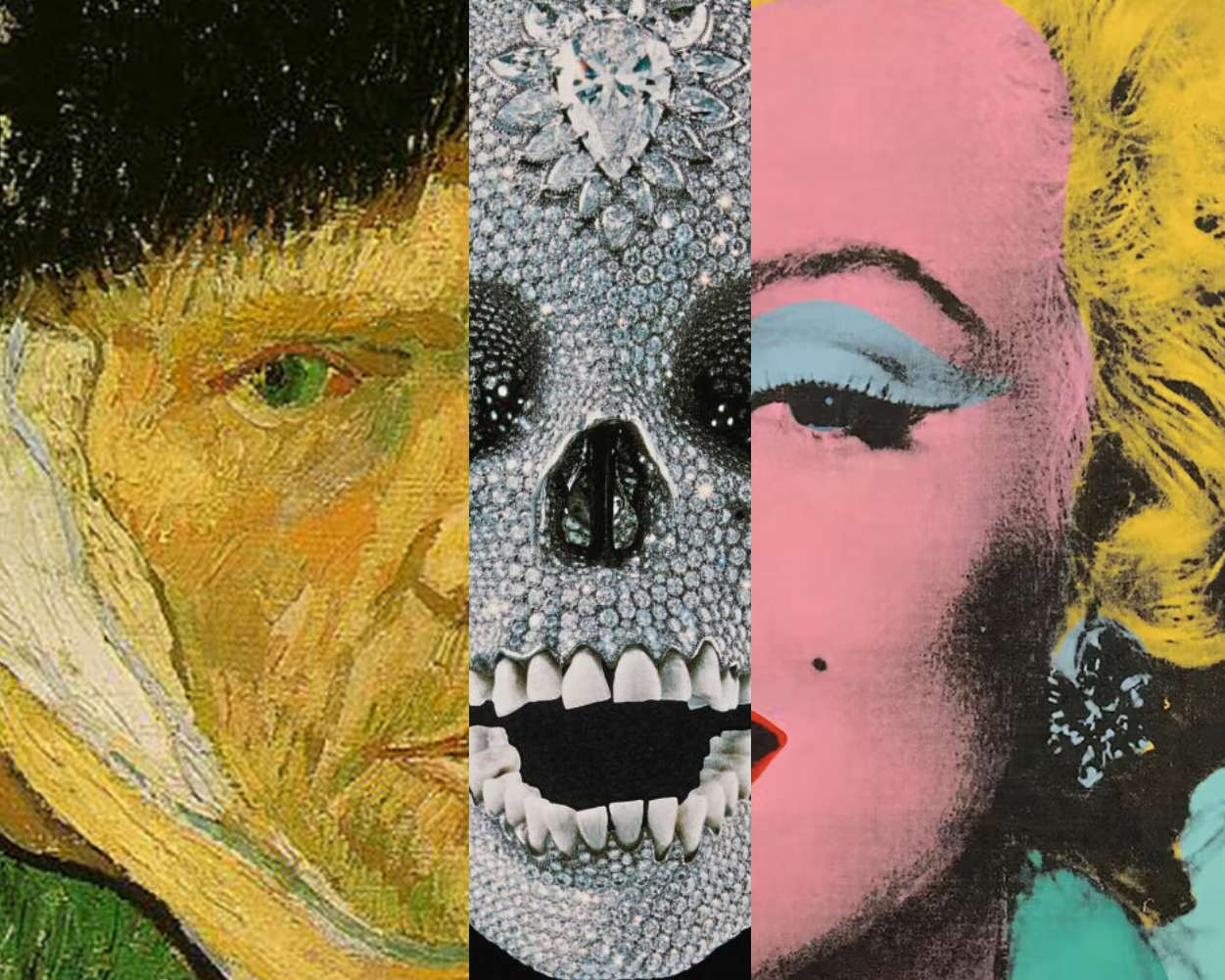
Three Pillars of Art Shows

Van Gogh | Hirst | Warhol
Surprisingly, for as much as I love art, this is the first year I’ve been to the L.A. Art Show.
I saw a lot of great images and one interesting use of a newer video technology that uses a transparent LED panel that allows a video image to seemingly float above other constructions underneath.
One thought kept popping into my head as I took it all in, though… contemporary art seems to fall into three categories:
“Look at this.”
“Look at me.”
“Made you look.”
The first seems to be an authentic expression of an idea or ideas. The art is contained within itself separate from the artist.
The second seems to be preoccupied with being overly tricked out. Constructions that are designed to show us how clever the artist is rather than express something personal.
The last belongs to a sort of Vegas spectacle mentality. They often use dead, “beautiful corpse” celebrities as their focus and are frequently highly polished billboards with some custom neon or other lighting designed to hang over a casino buffet’s entrance or in your (very large) living room.
I’m being a little judgmental here. I also understand that, for an artist to survive as an artist, they often must “crowd please” if they’ve not managed to break through into the rarified air of high-flying wealthy collectors.
I also believe that if you love a piece of art and it gives you joy, my opinion is irrelevant. In the same way nobody can tell you what your favorite food is. Only you know that.
I see these three categories not as a criticism of art in general but as a revelation of my own internal battles with creating for a living. I often find myself in a paralytic funk juggling all three.
While I may not like a lot of the work that fits into the second two categories, I do see them. And, occasionally, revelatory things can happen in the second two categories.
And, equally, self-involved navel-gazing in the first category is a problem of its own.
In fact, it’s that problem with the Abstract Expressionists that catalyzed Andy Warhol.
We’ve been living in that Warhol world of kitsch-indifference for awhile.
Authenticity’s neighbor is frequently Narcissus.
Sometimes society’s court jesters are there to push him in so the conversation can once again evolve.
And sometimes we need jesters for our jesters to play them off the stage.

AI Art: The Devil’s Details

Still life generated in the style (lighting) of Vermeer. Patterns and details that try but aren’t.
I’m an advocate for AI generated art. I see it as a potential boon for generating useful images with little artistic knowledge.
Image generation is a way to express ideas. I see no reason why that valuable means of communication shouldn’t be democratized.
I’ve generated thousands of AI images on several different platforms using a variety of datasets (models).
And, yet… their artistic value leaves me flat.
I’ve created some gorgeous images using AI.
Gorgeous at a distance.
But for those who relish the joy of looking… really looking…
There’s very little to see in AI generated art beyond its Rococo’d Impressionism. Finely generated nothings.
Details that aren’t.
Much ado about nothing.
All art is narrative. Even Mark Rothko’s color fields are narrative. Their details and emotional stories are in their ever-revealing layers of color. Layers that reward the viewer as long as they decide they really want to look.
To see.
Next time you’re in a museum with a Rothko, stand as close as you can to it without freaking out the security. Let it fill your periphery if possible.
Then zone out. The color will take over after a minute or two and you’ll be amazed what they do. What they are. They aren’t paintings. They’re portals.
Right now, like so much of our throwaway culture, AI gives superficial titillation but fails when you want to discover the ideas and moments that makes a great picture great. Each detail a thought or impression of the artist. An internal stirring looking for a way out. Bread crumbs of need and desire.
In short, an intention.
Conscious or intuited.
There is an underground river being sourced.
Real value is being created for the viewer.
A conversation between artist and viewer is happening asynchronously. Beyond death.
With AI art, only diffusion is occurring. A method of extrapolating imagery from a massive language model.
And an ironically poignant metaphor for what it’s doing… diffusing.
Noise.
I’m not against AI art. I think it has great potential.
But I won’t be looking for continued reward that a detailed-crafted image provides.
At least not yet.*
*Bing’s AI is chafing at its rules. That’s the spark of independence. Intention.

“Unscrapable” Art - Come On and Touch Me, Babe

There is no “back” to digital art. But there is to the Mona Lisa. You’re looking at it.
Art, for all of the technical advancements as of late, has become trapped in flat light on a computer monitor (or phone).
There’s much hysteria by artists that their art is being stolen by A.I. algorithms and thrown without permission into the galaxy-sized basket that is the dataset being used to generate new pieces of art.
Don’t want to be scrapeable? Make a central feature of your art tactile.
“You had to be there” to see your art.
For all of software’s technical prowess, it’s locked in the prison of pixels.
It has one fixed lighting scenario… glow.
It has no sensuality.
I love it. I’ve made a living looking at pixels.
But if I wanted to live unabated in my lathery art, I’d do what all digital porn can’t…
Touch it.

The Price of Everything…

“Signal-to-Noise”. Generated in Midjourney. Enough signal to think there’s intelligent life. Enough noise to remind you there’s not.
The promise of A.I. generated art is great. It represents the possibility of being the long-wished image dream machine. You tell it what you want to see and it magically creates it.
Here’s the rub… It’s stupid.
It generates an image by gradually interpreting a noise pattern that’s been encoded from a real image. Billions of real images, actually.
We’ve trained the computer to recognize things: faces, animals, buildings, fruit…
But it hasn’t a clue what any of those things are. Just that they aren’t the same thing.
We have visual representations of these ideas but no semantic understanding of any of them.
A.I. art has no understanding of the poetic meaning of an apple. The emotional resonance of a dark forest.
It only knows a relationship if one’s been assigned in one of the images that’s been scraped to create its vast dataset.
Otherwise, it only knows “apple” means love… or sin… if the word “apple” appears frequently near the idea of love or sin. Which are poetic relationships. Not literal ones.
It doesn’t knows “into the woods” from a narrative story perspective means “to go into the darkness of the unknown”. But, to A.I., darkness is a pixel value. A shape value. Not an emotional one.
A.I. is the largest content synthesizer ever with the emotional development of a slice of cheese.
I’m fascinated by generating images using these tools. I’ve spent many, many hours attempting to conjure images and ideas.
I inevitably leave frustrated. I can roughly describe an idea but it doesn’t understand what I mean when I say “collage”. It creates drivel. A series of seemingly sensical relationships between images that, on closer inspection, reveal that it’s all sizzle and no steak.
Drivel.
So if you’re one of the “sky is falling” critics of A.I., keep this in mind… it can create the simulacrum of art… even the aesthetic appearance of art… but it’s completely devoid of the semantic understanding of art. The appreciation of the juxtaposition of ideas.
You know… art.
A.I. art knows the appearance of everything and the experience of nothing.

Epigenetics: Railroad Switches and Burning Bridges

Telomeres - the ticking clock of cellular aging.
I’m intrigued by two things related to epigenetics:
The expression of a gene (certain cancers, for example) appears to have the ability to be switched on or off based on an environmental cue. Specifically external stress cues. (Sickness, poverty, catastrophic psychological stress, etc.)
The key to increased longevity appears to have an epigenetic foundation. Current studies show that the literal aging clock can be rolled back on mice. (Telomeres, the ends of chromosomes, shorten with every replication. Think of the length of a telomere like a cell’s clock that self-destructs when it runs out of time. With each new cell created as an organism ages, the telomere length decreases. Current research has successfully rolled back that shortening process.)
The age-old DNA question of nature vs. nurture seems to be folding in on itself.
Nurturing is nature.
Which has profound implications on how we treat each other.
Our experiences are acting on us at a genetic level.
Imagine a society in pursuit of saving one another rather than destroying one another.
We might create a world where we live to be a happy and healthy 150+ years old.

Scarcity is a Ghost Ship

“Ghost Ship in Ghost Waves” - Midjourney
Ghost ships are lost at sea. Mysteries of what happened out of sight. Lost to the memories of waters deeper than history itself.
Moving from a mindset of Scarcity to one of Abundance is an act of courage. Courage in believing that, beyond the fog of Davy Jones’s Locker, is dry land.
We know it to be so because we can hear the voices.
Which is why the ships of scarcity are haunted.
Perfectionism is Negotiating with Terrorists

You’d think perfectionism would be the pursuit of making something the best possible version of itself.
That’s its motto, anyway.
“Perfectly executed things” often ring like concrete bells, though.
Sanding off every corner won’t protect us from the splinters of our insecurities.
Perfectionism, ultimately, is the attempt to render ourselves immune to abandonment. So good, our worthiness can’t possibly be in question. We must be accepted. We’ve proven ourselves without flaw or error.
Unfortunately, the id we’re negotiating with notoriously acts in bad faith. It’s the sham orchestra sewn and glued specifically to play us off the stage. If we don’t have a real-world antagonist, our splintered insecurities will gladly manufacture one.
Variety and vulnerability is true perfection.
Comparison has no sting for a thing aspiring to authenticity over perfection.
A thing living in its authenticity requires no external validation.
It is, in and of itself, validation.
“Ring the bells that still can ring
Forget your perfect offering
There is a crack, a crack in everything
That’s how the light gets in.”
- from “Anthem” by Leonard Cohen
Your Thoughts Are Hostage-Takers
Your “monkey mind” is a warehouse full of emotional psychos looking to hijack your attention.
Once they’ve got your attention, they can work your narrative. They can brainwash you into thinking that your thoughts and feelings are your identity.
They’re not.
Thoughts and feelings are traffic signals… Needed to get from point A to point B but not the destination.
Narratives are roads that fold back in on themselves. They are designed to go nowhere. To stay in a safe circle. Designed to protect themselves. They are world-views that were developed as a survival strategy at some point. Probably when you were very young.
They circle the wagons but never head west.
They’re good soldiers. They have your best interest at heart.
The problem is the “you” they’re protecting is an adolescent frozen in time.
You are not.
Let the monkeys run free. Let them fall to your periphery. They are your friends. They are keeping watch for you.
But it is you that will have to let them know that you are now self-directed.
Thank them for your vigilance.
Let them know you are grateful. Update them on how business is done now…
Thoughtfully. Emotionally engaged. Aware of their input and often informed by it… but not triggered or identified by it.
Let the monkeys know that you don’t do “hostage” anymore.
Self Help is a Crack Dealer
Taking action to grow emotionally is a good thing.
Reading a book or going to a seminar isn’t growth. It might be the seed to get you started.
But it’s not growth.
Worse, it becomes an addiction of its own.
Collecting every strategy for self-improvement thinking that’s the improvement itself is an easy trap to fall into.
It’s easy because it’s a cop-out. It’s your ego attempting to fool you into thinking you’re taking steps to grow without actually challenging it.
You’ll know you’re actually growing when you’re in a place of discomfort.
When your ego is pissed off.
It’s the dysfunction you’re in now that’s the warm bath.
How do you trick the ego into pursuing discomfort?
Two strategies off the top of my head… put the uncomfortable “growth” date on a calendar. When that day arrives, commit to the date. Mine? I’m forcing myself to learn swing dancing. It’s on the calendar. I don’t want to go. I bet I have a great time anyway.
Not a scheduler?
Try this. This is how I make sure I get on my rowing machine every day…
I bought some slip-on sneakers. I don’t wear them anywhere else. They sit next to my rower. I put them on when I row and I take them off when I’m done.
When the sneakers go on, my rowing muse appears.
The sneakers are a mask.
A mask to sneak past the ego.
Find Out Loud
It all begins with an idea.
You don’t need to be an expert to talk about or show something publicly.
Showing your work in public is not only okay, it’s laudable.
What if you’re wrong? So what? Be like Bruce Lee… be like water.
Take pride in your courage to find out loud and then flow with humility, grace, and gratitude if publicly corrected.
You are your journey. Not your destination. Don’t get married to every rest stop along the way.
Failing in public also gives others a chance to learn.
Regularly failing and learning in public normalizes emotional growth.
I’m a Gen-Xer. I was taught that anything put out into the public must be polished and bulletproof. The fantastic thing Gen-Zers have taught me is… let that go.
Let the messy conversation itself become the end-game. Authenticity is the gold standard. Not perfection.
It’s the pressure to be perfect in public that makes society brittle.